
Intelligent Recommendation Systems Based on Behavior Analysis and User Preferences
26 September 2025
Intelligent Recommendation Systems Based on Behavior Analysis and User Preferences
As a manager, you know well that when the wrong offer is presented to a customer, they either abandon the purchase or turn to a competitor.
The reality is that in many companies, the offers presented to customers are still generic and mass-oriented. For example, in an online store, everyone is shown the same discounts; in a bank, all customers are offered the same products; in a tourism company, the same travel packages are presented to customers with different interests.
The way to solve this problem is to move beyond traditional mechanisms. AI-powered recommendation systems analyze user behavior and provide choices tailored to their real needs.
Now, let’s explore how this technology works through a few real-life cases.
1. Education – Online Course Recommendations
- Problem:
nline education platforms offer thousands of courses, and users struggled to find the most suitable one among so many options. This reduced learning motivation and negatively affected the platform’s revenue. - AI Solution:
An AI-powered recommendation system analyzed users’ past results, interests, and career goals to provide personalized course suggestions. This approach created an individualized learning path for each user. - Result:
Course registration and completion rates increased significantly. The platform both improved user satisfaction and optimized profitability.
 2. Telecommunications – Preventing Network Overload at Event Venues
- Problem:
During large concerts, sports games, and festivals, thousands of people use mobile internet simultaneously in a concentrated area. This leads to network congestion and a sharp decline in service quality. - AI Solution:
The recommendation system analyzes user movement and internet usage history prior to the event to predict traffic density during peak hours in that area. The system then provides recommendations to the telecom operator: install additional base stations, increase provider capacity, or deploy temporary mobile network boosters. - Result:
Internet quality for users in the area is maintained, complaints decrease, and customer satisfaction increases.
3. Insurance – Early Detection of Fraud Cases
- Problem:
In traditional insurance companies, fraud cases (fake accident reports, inflated costs, and repeated claims) were usually discovered only after lengthy investigations. This led to financial losses for the company and slowed down processes. - AI Solution:
The AI system analyzes claims to detect anomalies—for example, repeated accident scenarios, suspicious expenses, or inconsistencies with the claimant’s previous behavior. The model also collects data from social networks and open sources to predict the risk level of a claim. - Result:
The company detects fraud cases early, reduces financial losses, approves legitimate claims faster, and improves customer satisfaction.

What Is the Working Principle of AI Recommendation Systems?
AI-based recommendation systems go far beyond simple “showing a similar product” mechanisms. These systems are intelligent and dynamic platforms that recognize users in real time, analyze their behavior, and attempt to understand their intent. The process includes the following stages:
- Data Collection and Consolidation
- Behavior Analysis and Modeling
- Recommendation Generation
- Continuous Learning and Improvement
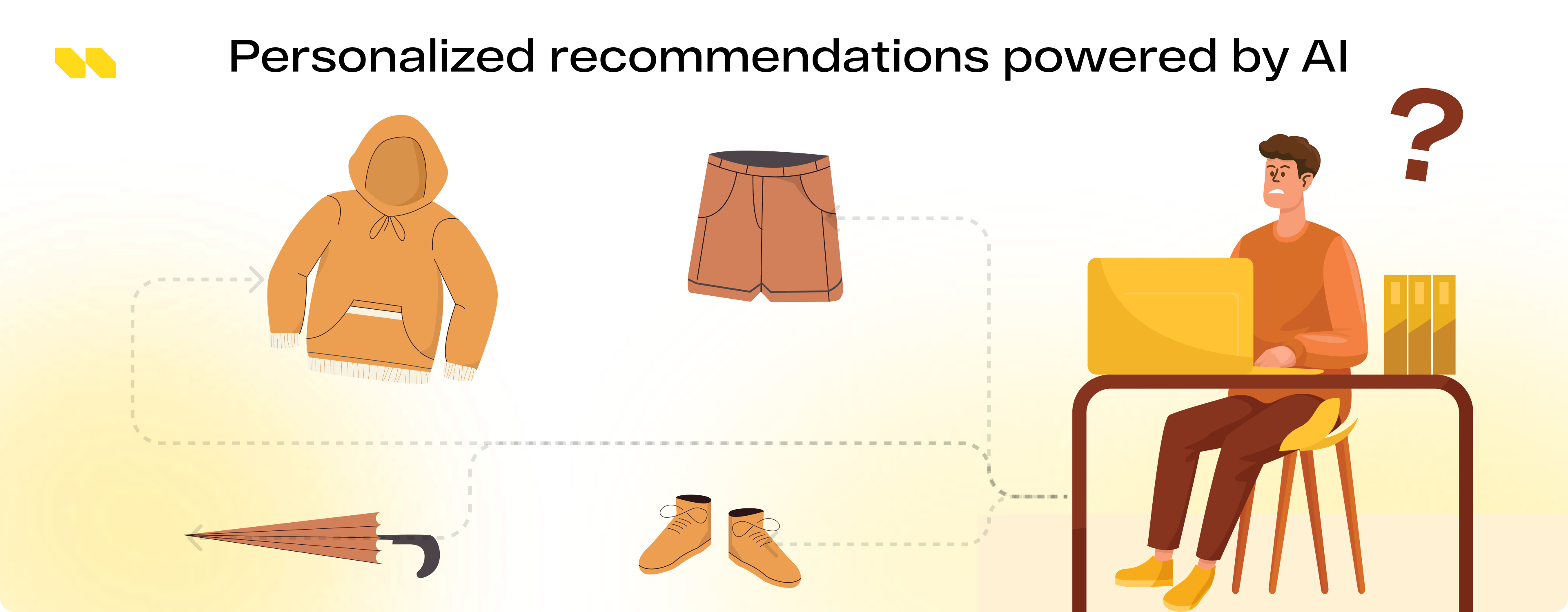
- Data Collection and Consolidation
User data such as clicks, orders, and browsing history is collected from tools like Google Analytics, Hotjar, and existing CRM/ERP systems. The data is then cleaned and standardized using Python. - Behavior Analysis and Modeling
Our machine learning models are built on TensorFlow and Scikit-learn. These models analyze the collected data to create a “dynamic profile” for each user. This profile is based on behavioral patterns and the user’s logical intent. - Recommendation Generation
Both “content-based filtering” and “collaborative filtering” approaches are applied here. The system provides personalized suggestions that match the user’s current situation and needs. For example:
E-commerce – products with a high likelihood of purchase or complementary items.
Media – films and series aligned with the user’s taste.
Tourism – vacation packages tailored to interests and budget. - Continuous Learning and Improvement
Each new user interaction serves as a training example for the model. Model performance is monitored with MLflow, while training processes are automated with Airflow. As a result, recommendation accuracy improves over time.
What Can BIRAINY Do for You in This Field?
When BIRAINY develops a recommendation system for your sector, the goal is to anticipate your customer’s needs in advance.
To achieve this, we first track customer behavior and performance. Then, our AI models process this data to suggest the most suitable product, service, or content for each individual user.
As a result, customers are presented with the offers they need most and are most likely to be interested in at that moment.
With these recommendation systems, not only do your sales increase, but your customers also experience the feeling of “they really know me.”
Now is the time to act. Let’s move away from systems that give the same recommendations to everyone, and instead use AI to deliver a unique, personalized approach to each customer—accelerating the growth of your business.